Health and Safety Policy for Landscaping Sudbury
 Landscaping Sudbury is committed to maintaining a safe, healthy, and efficient working environment for employees, contractors, clients, and members of the public. This policy sets out the principles and practical controls used across all landscaping activities, including site preparation, planting, turf care, hard landscaping, maintenance, pruning, and seasonal work. Our approach is built on prevention, clear communication, and continuous improvement.
We recognise that landscaping work can involve moving machinery, hand tools, lifting, working outdoors in changing weather, and operating near roads, pathways, or occupied properties. Because of these risks, health and safety is considered in every stage of planning and delivery. All tasks are assessed before work begins, and safe methods are chosen to reduce exposure to hazards while keeping the site organised and professionally managed.
Our policy applies to all personnel and to every work location. It requires a shared responsibility for safety, where managers provide suitable systems, supervisors monitor standards, and workers follow procedures, use equipment correctly, and report concerns promptly. The aim is to prevent accidents, avoid ill health, and ensure that landscaping services are carried out responsibly.
 Risk assessment is a core part of our landscaping health and safety process. Before work starts, hazards such as uneven ground, underground services, traffic movement, sharp tools, noise, dust, chemicals, manual handling, and weather exposure are identified. Controls are then put in place, such as barrier use, signage, PPE, safe lifting techniques, and restricted access where needed. When conditions change, assessments are reviewed and updated.
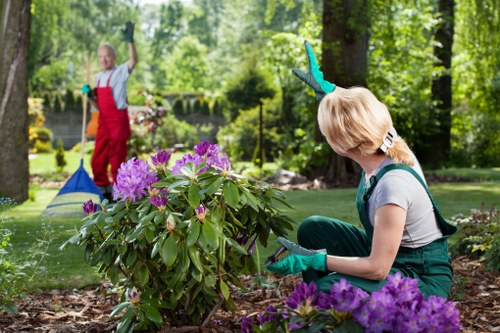
All team members are expected to use suitable personal protective equipment, including gloves, eye protection, hearing protection, high-visibility clothing, protective footwear, and weather-appropriate clothing where required. PPE is selected based on the task and maintained in good condition. Workers must also wear clothing and equipment that do not create extra hazards, such as loose items that could become caught in machinery.
Training is essential to safe landscaping operations in Sudbury. Staff receive instruction on tool use, equipment checks, manual handling, emergency procedures, hazard reporting, and safe working practices. New or less experienced workers are supervised appropriately until they can carry out tasks competently. Refresher training is provided when procedures change or when additional risks are introduced.
 Plant, tools, and machinery must be inspected before use and kept in safe working order. Defective equipment is removed from service immediately and repaired or replaced before being returned to operation. Guards, switches, cords, blades, and fuel systems are checked regularly. Only authorised and trained personnel may operate powered machinery, and all equipment must be used in line with manufacturer instructions and site-specific controls.
Manual handling is managed carefully because landscaping often involves lifting soil, paving materials, plants, and waste. Loads should be assessed before movement, and mechanical aids should be used whenever practical. Team lifting may be arranged for awkward or heavy items. Good posture, clear routes, and proper storage reduce the chance of strain or injury. Repetitive tasks are rotated where possible to minimise fatigue.
Working outdoors presents additional risks, including heat, cold, rain, wind, slippery surfaces, and reduced visibility. Landscaping Sudbury expects work to be adjusted according to conditions. Breaks, hydration, shade, warm clothing, and weather monitoring help protect workers from environmental stress. If conditions become unsafe, work pauses until it can resume safely.
Control of hazardous substances is handled with care. Products such as fertilisers, fuels, cleaning agents, herbicides, and other treatments are stored, labelled, and used according to safety instructions. Exposure is reduced through correct mixing, careful application, ventilation where relevant, and safe disposal of waste. Spills or leaks must be contained and reported immediately so they can be managed without harm to people or the environment.
Public safety is an important part of our landscaping health policy. Work areas are arranged to protect clients, neighbours, pedestrians, and visitors from moving plant, falling debris, trip hazards, and restricted access zones. Where appropriate, barriers, cones, and warning signs are used. We aim to keep sites tidy and controlled, with tools and materials stored safely when not in use. Clean working areas support safer outcomes for everyone.
Emergency procedures are maintained for incidents such as injuries, fires, equipment failure, and severe weather. Workers are expected to know how to raise an alarm, where to assemble, and how to respond to common emergencies without putting themselves at further risk. First aid provision is kept suitable to the size and nature of the work. Accidents, near misses, and unsafe conditions are recorded and reviewed so that lessons can be learned.
Supervision and accountability support consistent standards across all landscaping operations. Supervisors check that safe methods are followed, that workers remain fit to perform their duties, and that the site remains suitably controlled. Managers review performance, investigate incidents, and act on findings. This helps ensure that landscaping safety is not treated as a one-time task, but as an ongoing responsibility embedded in daily practice.
Contractor and subcontractor control is also included in this policy. Anyone engaged to work on our behalf must meet required safety standards, provide suitable competence, and cooperate with site rules. Coordinated planning helps avoid conflicting activities, especially when several trades are working in the same area. Communication before and during the job reduces confusion and supports safer delivery.
 We also promote occupational wellbeing. Landscaping work can be physically demanding, so fatigue, hydration, rest, and work pace must be managed sensibly. Workers are encouraged to speak up if they feel unwell, overloaded, or unsure about a task. Reporting concerns early helps prevent minor issues from becoming serious incidents.
 This health and safety policy is reviewed regularly to make sure it remains suitable, effective, and aligned with current working practices. Feedback from inspections, audits, incident reports, and operational experience is used to improve standards. By maintaining clear procedures, proper supervision, and a strong safety culture, Landscaping Sudbury aims to deliver reliable services while protecting people, property, and the environment.